
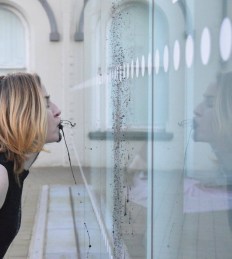
Sáerlaith Molloy performing Spit it Out, (2016),
“Sáerlaith Molloy is a performance artist that I first came across in 2018 at the K-Fest arts Festival, where she deservedly won their Screaming Pope Prize.” Sáerlaiths exploration of themes made for an amazing interview, as with many great artists you can see her evolving thought process through her work which makes her a very rewarding artist to follow. I’d like to thank her personly for being such an open and generous interviewee.
A recurring image in your work is the mouth – how does thinking about language influence your work?
I began teetering on using language in my second year of college – Labial would be the earliest example. I’ve always been interested in the idea of language, this idea of. When you speak, it’s only there for a moment, then it disappears or evaporates in a sense — that idea of how the spoken word is only there for a moment, for a second.
Language is so versatile in the way it can move or change – we speak English, and we have our own native Irish language. The Irish language is full of exaggerations! In Irish, when they describe water, they don’t just describe it as a stream, or as waves: they describe the waves as horses galloping. Like these almost magical extra added bits of language. My bible during my research was Describing Language, by David Graddol, about the origins of language – like where it came from, how it has developed in places like Ireland, and the shared kind of umbrella that Irish and German and Scandinavian languages come from. And just, you know, more about the physicality of the mouth, the ways the tongue can move and create the noises – how your tongue goes flat for ‘N’, and fat for ‘V’. How your lips would press together for ‘M’ or how your lips are open for a little bit for a ‘V’…
My niece was born four years ago, and watching her learn how to talk was like a lightbulb going off in my head. Seeing how she’s a growing woman, learning by looking at the likes of you and me speaking. Looking at how we move our lips and how that was all going on in her head. And her body was training itself to mimic these sounds, and I remember recording her and just listening to her, watching her trying to say things after my mother or sister had said something. Through that, she learned that your mouth is just an amazing part of your body.
So I was trying to see how all these things could feed into some type of performance work. At the time I wasn’t ready to perform yet in a space, but I just felt that this kind of a retelling of the story – using myself as a medium, as a way to retell something that I think – it needed to be heard. My mother had stories that I felt needed to be told. My grandmother had passed away while I was in college, and there was a lot of things I hadn’t been told about, the stories she would have told my sister and my mother. It’s such valuable information, and it is all about tradition. It’s all very connected. I could alter and distort the material itself, but also get that message across; that connection and how stories change over time. So that is where it’s really started.
Labial is a series of Holographic sculptures/videos of my mouth mirrored and edited in a way that they only produced very simplified speech. Like it was broken down to the simplest abstract noises.
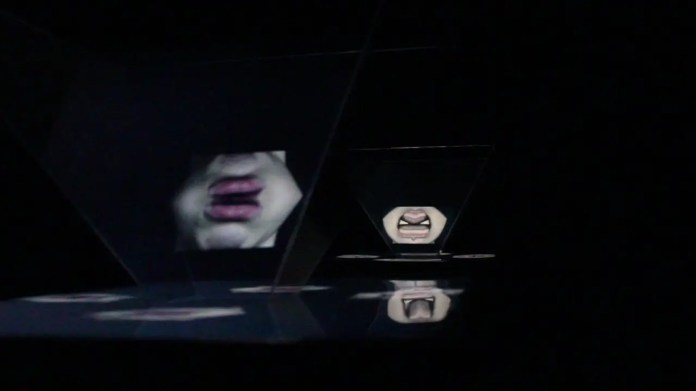
Labial, (2016), Video Installation, Inverted Truncated Pyramid, Acrylic Perspex
I have this real interest in speech development and experimentation, and that is where Labial came from; breaking down speech into quick movements or sounds and put them on repeat making an uneasy parallel, and this repetition makes you aware of what going on. You’re aware of the mechanics of it. At that time, stepping out into space by myself was still very daunting for me, so that’s why Labia was a video piece that turned into a hologram. I created a person, with these two heads that were having a conversation with each other, kind of grotesque in that way, primitive… they were very pared back to the beginnings. Just very raw. Labial will be something I will always be very proud of, and I think it’s been a pivotal moment where I realised this is what I want to do.
Would you say the body is an essential tool of sorts in your work?
I don’t think it’s an accident; it is very much a crucial part of my work. You know with a piece of work when you try it out for a few times, and you will feel that doesn’t work, or this works, etc. – every time I kind of delved further with a piece, I found it was when I used my body a lot more. I always say my work is like I’m creating a conversation; I come in, I’m having a conversation with the audience, and I’m having a conversation with the space I’m in. I’m having a conversation as a woman, with you as a man. Or even more specifically as a woman in Ireland. So there are all these kinds of layers. Maybe in the future, I’d like to invite other people and see how that works, but at the moment it’s just making use of my own interactions. I find that the conversations I’m having are incredibly personal, even when the resulting physical product is extremely abstract.
Gurgle was your next project, and there’s a real physicality to that work and your performance, would you agree?
I’ve performed Gurgle three times – once in college for a degree show, which is kind of a bubble of an environment, and then in K-Fest, which surprised me cos how open people were. I then performed it in Denmark, and likewise, people were extraordinarily open and just wanted to talk to me after.
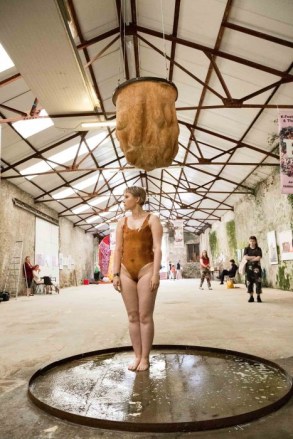
Gurgle, (2018), live performance, latex boob balloon, coloured water, performer., [K-Fest performance], photo by David Hegarty
I think endurance is extremely important. I know people who perform with a set time and they would have their movements planned out for the whole performance. They would have a set list of everything they’re doing, a plan in their head. I do have a plan, but I’m not necessarily thinking, ‘I’m five minutes into the performance, I have to do this now!’ That element of endurance, working with the progression of time, I think that’s the real essence of performance art for me.
I’m very much about being in the moment, and I think that’s what performance is all about? If you talk to any performer, they’ll tell you once you are in that zone, it’s hard to describe. Once I step out there, I just completely change, I just go into a completely different mode. And it’s only when you’re there in that zone for a while that really interesting things start to happen, you really begin to work with your body. And you don’t realise it; it’s very in the moment and very intuitive, which is what a lot of performance art is entirely about. It is all about your intuition.
I remember when I worked with Amanda Coogan, I literally had just been given
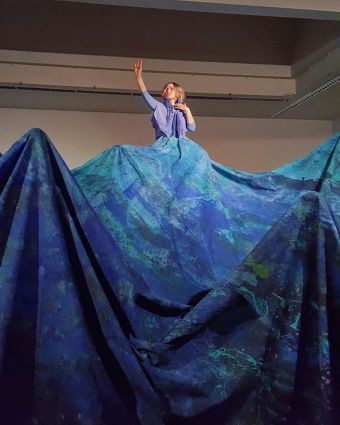
Sáelaith performing Amanda Coogan’s ‘You Told Me To Wash And Clean My Ears’ (2016)
something and was told, ‘go into that room and just play around for a bit’, and then the next day, you’re doing it! The first time I did it, I was thinking, ‘oh god am I doing this, right?’ But when the time comes for the performance it switches into this kind of zone, and you almost feel it, and I think that is what really amazing. You switch off all those stupid things you think your head, you have to think: fuck everybody, you’re there to perform! You could perform to nobody, but you’re still going to perform because you want to get into that zone, you want to see where things go and how far they will go. And it’s incredibly empowering.
So yeah, I’m seeing how far I can go, and test my limits in some ways. And sometimes it’s, ‘oh no that’s it; I can’t do any more.’ Like with Gurgle, for example, I was messing around with it, like I could go with this for a long time but after a while, I’m going to start hurting myself. So thirty minutes is my maximum! It was kind of a serendipitous accident actually, where I filled that balloon full of water, and I tried it myself for the first time – just as my throat started hurting, the water just stopped, and I checked the clock, and it was thirty minutes exactly. And I just felt – it felt right, you know?
Pillow Talk is another work of yours that has a similar endurance element.
When I was doing Gurgle for my degree show, I had Pillow Talk in my head. And I was thinking about the mouth and looking at how it moved and wondering how I can create a physical presence of language. Considering I was talking earlier about how fleeting it was, the follow-up was to ask myself, how can I make the conversation permanent? How can I make it last without it being the physically written word? I wanted an alternative mode of mark-making, using my mouth, using the core organ of speech. Pillow Talk was a thirty-minute performance where I was putting lipstick on my face, starting with the lips and moving out around the face to completely cover the head, and then lying face-first into a pillow and reciting a dialogue about my life at the time. Which was about how I just was always calculating in my head, how much time I had, things like that – it was a kind of anxious time for myself, in terms of my mental health. And the movement and the face imprint then became my pillow talk to myself. We all know ‘pillow talk’, as a term, is the kind of talk that you have at night, but this was to myself – this kind of reassurance, that everything would be OK for the next day. The imprint that was left on the pillowcase was my conversation.

Pillow Talk, (2017), Live Performance, a pile of pillowcases, lipstick, two spotlights, a pillow, a mirror, performer.
We’ve talked a lot about the performance part of the equation in your performance art, but there’s also a lot of interesting constructed elements to your work as well – I’d love to hear your thoughts on that side of things.
I think sculpture has always been part of my work. With an object that I use in my performance, it being something I’ve made is really important to me. The work is of the body, so it makes sense for me to use my hands to create a mould of my body.
The balloon you see in Gurgle, that was very hard! It was about six months in construction. It started off with a body-safe silicone mould of my right breast, and from that I made loads of different copies of it – copies in all types of different materials, to see what would be sturdy enough. Initially, I was going to make it from something extremely hard because my thinking was it had to be hard to hold water, which was a total waste of time!
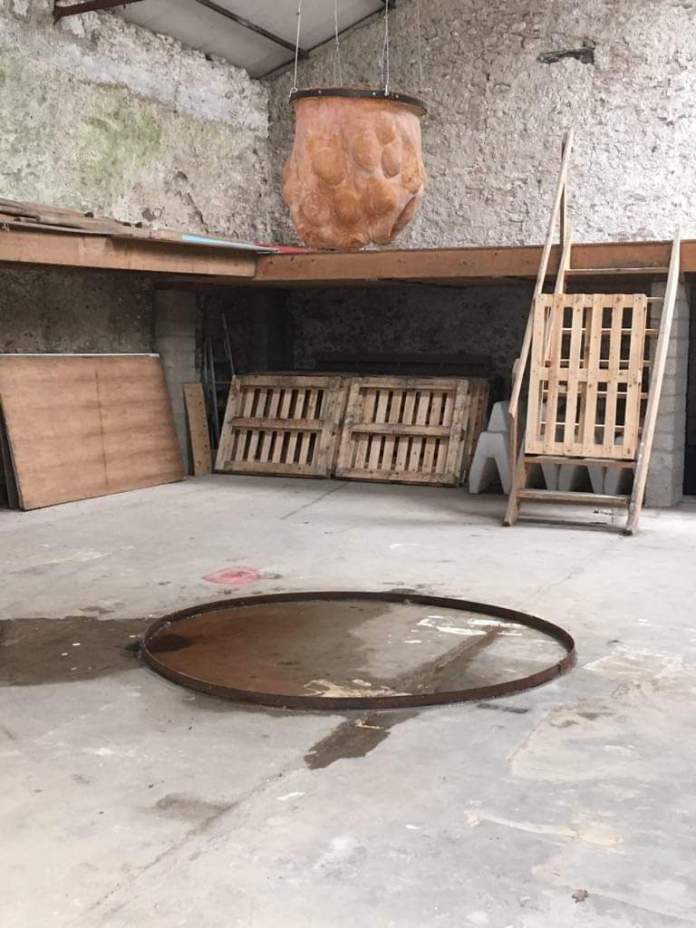
The balloon from Gurgle
Now I’ve always been interested in latex as a material because how you can use it. It is so free as a liquid, and it is still quite flexible once it sets, so I had made my cast – my candy dish, as I call it – my breast mould, and from that, I started making a physical positive in plaster 3D. I had a kind of frame, a big wire mesh frame kind of structure, and I began to place these plaster positives of the boob on the frame and gradually built it up using wet plaster. And then filling in the gaps, smoothing it, sanding and shaving everything to make it as smooth as possible, so when it came to applying latex, I could brush it on to get the fine details of it. I would do about 15 layers, and once that was set, you have your boob made! It was a lot of trial and error, but interesting because of the use of materials and just the experimentation involved – a resin version, or a gypsum one. You know, whatever really. I was trying to see what would be the best material. That kind of trial and error was critical.
You perform with a performance art collective called Evil, tell us a little about them.
We’re all performance artists based in Ireland. There is a good group of us, roughly around ten. We all went to LSAD, and we are trying to bring art to a more public space. Kind of taking that ‘intenseness’ out of it and making it more accessible. By making it more enjoyable, people can come, and they can sit down, have a drink.
We have meetings beforehand to see who wants to perform at the event. The group gives the option for artists to collaborate, two of the artists Niamh Dorgan, and Aoife Lee . actually collaborated on a piece together at one of the performances not long ago. It’s all about getting a space for us to continue our practice – it’s something we hear a lot, how it’s very hard, when you leave college, to maintain your practice. You don’t have a studio, you have to fend for yourself really, so collaboration is something that can really help to keep you going.
It’s a platform, but it is making me more determined to keep it up and make new work in order to show to develop my practice. Particularly now I’m out of that art college kind of bubble. It’s making me want to keep going, showing new work, and it’s always really good to have like-minded people around you – it’s a good influence. We all bounce off each other. It’s something I’ll continue to develop.
You can find out more about Sáerlaith Molloy’s work through her website link below
http://www.saerlaithmolloy.com/
thank you Adrian Mc Hugh for your work editing


 Painting in Text