Installation, Interview

Impermanence and its Lasting Impact: Shane Finan

Shane Finan, a Sligo-born artist currently residing in Dublin, is a man who wears his influences on his sleeve, and it’s riveting to hear him discuss them in detail.  His work is uniquely his own, and I’m happy to give him a platform to discuss his art and his process in this in-depth interview.

This transcript has been edited by the interviewer for the purpose of this blog.

So, what are you currently working on?
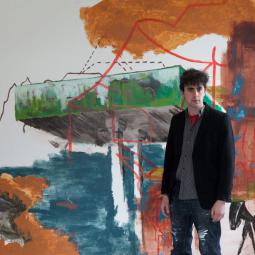
foto-56646_39073_13828_t

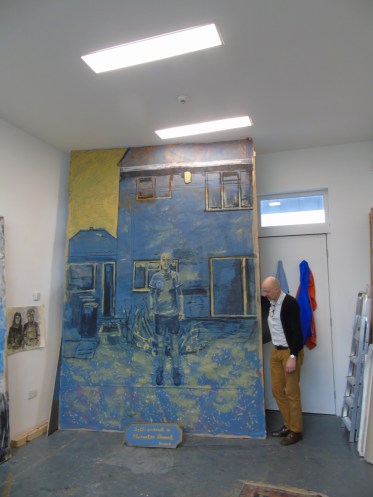
Shane Finan standing in front of Everything’s Ephemeral (2016)

Well I tend to have several things on the go at the same time. I just made a list yesterday in an Excel document, it’s the only way I can organise my life these days! At the moment there are seven or eight different art projects ongoing, and I have to keep track of what stage they are at and what I need to do with them. Some are in the documentation stage, some are in the fledgling ideas stage. Probably an interesting one to talk about for my practice would be the project I’m doing with the Pierre Auger Observatory, because I just finished the research and I’ve just started onto making something.

I should probably explain.

The Pierre Auger observatory is based in Malargue in Argentina. They detect showers of cosmic rays, which are radioactive particles that are constantly moving through space. A lot of them hit earth and pass right through it and continue on their journey – their intergalactic journey.  What they have in Malargue is thirty square kilometres of water-pools with sensors, in a desert in the Andes, that are there to detect these rays. They are set up to detect why these showers happen and where they come from. And only this year, they published a paper saying that the major showers come from one specific area in the universe. This is ongoing research. Why that happens? We don’t know. But it’s great for speculation. From my point of view this is fantastic – it could be communication from aliens, an exploding star… you could come up with or create anything!
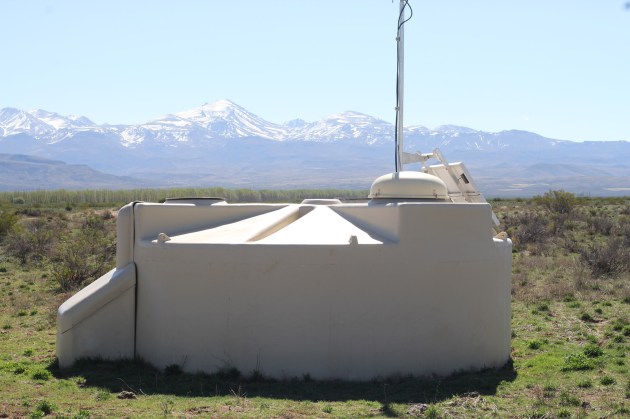
surface_detector_reduced

surface detector from the Pierre Auger observatory


The project came about around twelve months ago, when I got in contact the director of The Pierre Auger observatory. I dropped them a line and I said, ‘Hi, I’m an artist and interested in getting involved in making something off the back of the research that you have?’ And they said, ‘This is great, we would love to have you, and anything you need let us know. Tell us when you’re coming!’ As an artist I have found this reaction sometimes, and it’s always very heartwarming when people are interested. The director put me in touch with a few people who have written papers, and so over the following months I gained a very small knowledge of what the observatory did. My method is so based in research – I do so much reading. I read a lot of theory. I read magazines, newspapers. I love reading material. Reading in general, and listening – I listen to a lot of music constantly, sometimes podcasts too. I also take photographs and collect physical material, drawing up sketches, and being on site when I can. I get lost in my research. I like to have a lot information streams coming at me all the time. I would say if you were to measure it, research is around 70% or 80%, and the actual execution of a piece is quite quick in most cases.

When I’ve gotten through the research I begin to get a picture of what I plan to do. For instance, I will probably be doing a digital installation off the back of this – it just fits with the material that I have. For me, medium is dictated by the best idea communicated by my research, whatever that ends up being. That doesn’t mean I’ll always make something! Sometimes I will realise through the research phase that a project won’t be going any further. I might write a paper about it, which I’ve done a couple times before, or I might just leave it and let it disappear into the ether.

I chose digital installation because I feel I couldn’t express it through a lot of other media. Film or painting wouldn’t get it across across. I want to disseminate what they are doing in the observatory – the type of work they are doing, and the type of research, but also the idea of technology in its highest form being used for a purpose which is experimental and undetermined, I guess. We don’t know where this is going to go, and when the funding finishes up in ten years’ time this will all be cleared out – the buildings and technology will move on to another purpose. They might give some of the 1,600 water tanks to the local farmers, but the observatory will be gone.

Maybe what they learned will be useful at some point. We have this huge experiment – a staff based in western Argentina, from all over the world. And then at the end of it, you know where cosmic rays are coming from, and that’s it! You have this piece of information that maybe ends up playing no part in human progress, but it is fascinating nonetheless.

Technology seems to be a recurring theme to your work. 

I tend to focus on transient ephemeral things that disappear over time – things that change the relationship between people and place. Technology is one of those things that is constantly shifts and is constantly in flux…  something else I’m interested in is the idea of lost technology or lost ideas. I started a series called ‘Antikhytera etc.’ in 2016, that is all influenced by this idea: lost technology.

The first piece from this series was a project about the Chernobyl disaster – Mugwort, Wormwood, and how little we know about the end of the world. (I made that title as long as possible so it can’t be repeated.) At the time I was looking at the history of the Cold War era coming to an end, and the influence of that on a place like Ireland in a global community. There were a lot of great ideas in the technology from the Eastern Bloc, lost after the wall came down… there was a lot of propaganda in the West, that led to the belief that behind the Iron Curtain there was no such thing as a good idea, but these people put cosmonauts in space!
mw2.jpg

Mugwort, Wormwood, and how little we know about the end of the world (2016)

It was something I was interested in, so I checked out everything around the Chernobyl disaster. Which was an interesting personal event as well, because it only happened four months after I was born. My mother told me a story of bringing me out into the town when I was in the pram, and it was raining –there was so much fear and paranoia, that this could be acid rain. So she rushed to get me into the Quinnsworth Arcade [in Sligo town], to take shelter. That kind of hangs with you for the rest of your life. in fact, I looked back at my research from my first year in college and found old notes on Chernobyl, and realised that this had been rattling in my head for a long time.

All that led to me looking into the history of Chernobyl, and specifically the history of the name Chernobyl – which caught my attention, because Mugwort and Wormwood are both etymologically linked to the word Chernobyl. Mugwort was also the star that heralded the end of the world in the Old Testament. There is an interesting relationship between the blinding light which comes from a radioactive star, and a blinding light that explodes from a centre inside of the USSR. The Chernobyl disaster really marked a point where it was visible to the western world that something disastrous on a global scale could happen beyond the Iron Curtain, and it could affect people beyond it. This notion of the local-global and the end of the world, it’s striking. And what is an end?  Is the fall of the Iron Curtain an ‘end’? It caused a major social shift. That question made me think about location and social identity based on the local – which led me to Wormwood Gate in Dublin, which my partner Amy found along one of the points on the old city boundaries. I wanted to do something local that was responding to a global idea. I was very heavily influenced by the Nobel Prize laureate Svetlana Alexievich and her book Voices From Chernobyl, where she interviews eyewitnesses, and explores the experiences of individuals and how the disaster affected their lives.

Can you talk a little about your practice? You mentioned the relationship between people and place as an important theme for you, as well as the notion of transience, the ephemeral – how do these concepts influence how you work? 

Something that I think is relevant to my practice that I haven’t mentioned yet, and I should say before talking about the piece, is that I stopped working with galleries, and generally with all traditional exhibition spaces, around six years ago. Around 2011 was the last time I showed in what would be considered a gallery space. I will work with artist-led studios and art centres, but generally I like to work in spaces that aren’t art related at all. I like to work with places that are transient – as an art space, but also transient as other spaces, and this links to my thoughts on the idea of commonage or the public sphere. The public sphere was essentially a place where everyone would meet up at a specific spot (like, say, the drinking well), and this is where you would have all this communication, because they all have to go to the well anyway. But they don’t just use the well as a place to get water – they use it as a place to have conversations, to open up dialog and to get news. Really, this dual use of spaces resonates with me, and I want to be a part of something like this. There are legitimate criticisms of the theory surrounding this concept [of the public sphere], and I’m aware of that, but as an ideal for me it is fantastic.

btbs_charlestown_arts_centre

Beyond the Black Stump (2017) at the Charlestown Arts Centre (a multifunctional art centre / library / music hall / community space)


I find audiences extremely important, and I think that when you are dealing with places that are established you are dealing with audiences that are already established also. In galleries, or on that route, I’d be speaking to the same audience as every other artist. Artists speaking to other artists is fantastic in a sharing ideas sort of way, but it’s not the be all and end all. I have had some success selling paintings a few years ago and that was going quite well, but I started getting pigeonholed a little bit by galleries who wanted me to do more of the same. You know what I mean? I’m not going to do more of the same, because I’ve finished that series and now I’m moving on to this series. I don’t want to work that way.

So in Wormwood Gate in Dublin, I set up the work. It featured lights that were triggered by pressure sensors, and the sensors were activated through interaction from viewers. The layout of the sensors matched the shape of the biohazard symbol; the layout of the lights formed the shape of the exclusion zone surrounding Chernobyl plant, days after the reactor fire. The idea was to create an impression of an exclusion zone, but one that could not be properly interacted with unless people stood on all sides (a minimum of three people). Otherwise there were constant ‘gaps’ in this zone. The piece becomes an ‘inclusion zone’, inviting people to move closer and become a part of the work, rather than remaining outside and forbidden to enter. I wanted it to act like a public space of some kind – a point of discussion, of mystery and reflection.

With research being a huge part of your process, how have you found the task of adapting your language to the audiences less versed in much of the theory you’ve been reading?

I suppose I communicate through my visual language anyway. My visual art is a form of communication as far as I’m concerned, and I think that if you spend enough time with an art piece you will understand it even if you have no background in art.

I don’t think I change my practice for an audience. I like to keep the ambiguity that I put into my work. I don’t change my practice for the audience – I don’t want the ideas to be in their face, but I don’t want to be to ambiguous either. I want people to read into the work the way they want to read into the work, which makes me think a little of watching the new season of Twin Peaks. There was one episode that I just watched there, and it has half an hour of mad avant-garde 1950s-style filmmaking, with a nuclear bomb going off, followed by another half an hour of black faced people coming through speaking in tongues! And as I watched this I felt: anyone could enjoy this. And I love that David Lynch is doing this in the form of a popular TV programme to entertain and confuse the hell out of people. He doesn’t compromise, but he trusts the audience to work with him to find meaning. If it is well written and well made, they will get something from it.

Funnily enough, when you make me think about this, I guess one thing has developed since 2011 –  I kind of insist that I do a talk with every piece that I do now (I do like to talk! haha). And I practice quite vigorously for these talks, to the point where they become kind of performance pieces and part of the work. I don’t generally talk in a very straight line either, but I always try and communicate in the missing pieces for people who might not know my background, or don’t know my way of working, so I try and bring that across in my talks. And I find that people are often interested engaging in conversation and dialogue after looking at the work again in a different light. So yeah, that has become more of my practice since I stopped working in galleries.

You have such a broad set of tools when it comes to approaching a project – how do you see yourself as an artist?

I’ve been reading about specialisation. One thing that jumps out is the book Chronicles, by Bob Dylan. It’s a fantastic book, where he really defines his point of view as a musician. The artist as musician – he’s not thinking [wholly] about songwriting or revolutionary causes, he’s thinking about being a musician as the thing that is important to him. It’s a form of identity and that singular identity of ‘this is what I do, and this is what I do well’ has been reviewed in what I have read over and over in other sources. I think sometimes that’s the only way to really perfect something – a process or a practice. But saying that, I like being scattergun. I’m not a specialist in anything, but I can be good in a lot of things, and I like that. Sometimes it can be disappointing because it can lead to having more failures, when I have grand ideas for projects because I’m got good enough at programming or I haven’t figured out how to paint something well enough. But it allows me a broader scope, which I’m grateful for. This way of working also opens me up to collaboration with people who have better skills, and that is an important part of my work. A lot of what I have done recently has been collaborative, and I love to develop ideas with other artists or people with other skills or ideas.

You can find out more about Shane’s work through his website

http://shanefinan.org/visual_art.html
thank you Adrian Mc Hugh for your work editing
 

You can support Painting in Text through Patreon, link below

https://www.patreon.com/PaintinginText

Standard
Interview, Painting

Ways of Showing: Andy Parsons

Andy Parsons is a Sligo Based artist whose work has been shown in Amsterdam, Dublin, London and Tokyo. Andy is not only a painter. But a curator, critic and facilitator. In this interview we talk about these many facets of his practice and how they effect each other. from his Floating World project with Glenn Holman to the Per Cent for Art scheme Play Spaces and his concurrent painting at the time.

This transcript has been edited by the interviewer for the purpose of this blog.


DSC00044

Andy next to his self portrait

How would you describe Floating World?

Floating World has used the Artist Book as a catalyst for complex participatory projects. Floating World was started by me and Glenn Holman in 2002 – we were very interested in making artist books and putting them out into the world, somehow. Books as a format has a lot of benefits: it’s cheap, you can move it around easily… it’s a format that people understand. You open it and you flip through it. It can be in many places at the same time. The books could be shown in different venues, some gallery venues and non-gallery venues. You could fit a whole show into a box and send it somewhere. Or that same box could fill a whole room.

It was, and is, an unusual model because we asked people we knew that had an interest in books, to make books. It was and is a very informal structure where a number of artists contribute books, me and Glenn being the administrative… kinda curatorial centre of it. The books were very short editions, some of them were one-offs.

The first thing we did was the now defunct ICA book fair, that went really well, and we sold the books in the ICA for about three years. We then configured it so it could be shown in galleries: what we did culminated in a big show called Unfolding the Archive.

Unfolding the Archive?

Unfolding the Archive was a show curated by Riann Coulter alongside Donna Romano. It was all of the Floating World artists responding to things in the NIVAL (National Irish Visual Arts Library) collection in NCAD. They had this huge collection of old books and publications posters, what you might call ephemera from the production of art since the 19th century. Really interesting stuff – unpicking the mechanics of art making. What each artist did was to make a book or [something] book-like, as well as create other objects alongside it.

And your own Involvement?

So I made an artist book about making a raft, but in order to make the book, I had to make the raft! The raft was used to draw on, so it was a drawing board which I sort of sat on to make drawings of the lake isle of Innisfree. Because one of the things I was responding to was a 1st edition of Yeats’s poetry, that and a brilliant poster from the 1970 which I found by accident.

And the show itself?

For the show this is plural – there was one in NCAD and the F.E McWilliam gallery. There were the books and then there were the objects. So for me there was the book about making the raft and the raft itself. there was quite interesting things about the nature of artist books, in essence the artist book was the thing the raft was made to make the artist book, there was a flipping the traditional hierarchy. Normally you get a big art object and maybe publications are made as a peripheral thing to it.

What have you been doing since Unfolding Places?

Since then, me and Glenn have concentrated on a project, The Rebel(s), it’s based on a 1961 movie called The Rebel by Tony Hancock as a starting point. Basically The Rebel(s) is an artist’s book that uses the Movie as a starting off point.

The-Rebels-SPF-680x962

The Rebel(s), promotional poster

For me and Glenn, the project is also interesting because it’s about not really understanding the art world, but really liking to make art! And in the film, even though it is quite satirical and quite reactionary in some of its positions it takes on the art world and the making of art… at the end of the film Tony Hancock’s character goes through a series of mishaps and fails spectacularly as an artist, and his life is trashed, by [the end] he is back where he starts making this godawful sculpture. So it’s about navigating through the art world and taking the all the shit, and then still wanting to make art despite all that.

So for instance, there’s a private view scene at the end of the film where Hancock’s character presents the work he has made to the public. With that in mind, we recreated a private viewing in my studio here, and we made cardboard cut-outs of the kind of people we’d want to come – Hans-Ulrich Obrist, Charles Saatchi and Larry Gagosian at the viewing. If you have seen the film Lonely Guy by Steve Martin, there is a fantastic scene where he has a party in his flat with cardboard cut-out film stars,  which was kind of the inspiration for it. That idea of re-staging things but differently but also being quite funny and poignant.

A little bit like The Raft, you create all this stuff – you make all these objects, you do all these quasi-performance type things, and then weeks of work can be like one photograph [in the book], and it’s, like, 128 pages. That’s why it took a year and a half!

Glenn lives in Suffolk but spends a lot of time London. So, we decided that Floating Worlds would be based between Sligo and London. When we started it, we were both in London. I feel that distance has improved it, in the sense of… rather than leaping in and following impulses, you have to have that “cool off period” where everything has to be done via Skype or email. It makes you more analytical. You can’t just have enthusiasm and follow it up – everything has to be that bit more meticulous. Without Skype, you would be stuffed, but I’ve been over there and he has been over here a lot. A lot of the things have been made quite independently, but there is a shared authorship.

What do you think of the book now that it is done?

The book is kinda quite sad… I think it’s quite funny, but also quite sad. Still, there is this sort of redemption in it. It comes from our love of making art, despite the cynicism of the workings of the art world. We couldn’t have made this twenty years ago. I don’t think we could have made it ten years ago! It’s about being old and still wanting to make art.

The other thing about it is that it’s happened while at the same time we have made our own personal, not collaborative, work as well. These pictures you see around have been done exactly contemporaneously with the book.

Would you say that the book has influenced your painting?

Yeah – I think the making The Rebel(s) has made me think about conformity in the art world, and how much of it there is. I think it has kind of emboldened me to make very, very… unfashionable work. I suppose I care less about what an audience might think of these objects, because making the book has made me think of the patterns of behaviour that we ride – and sometimes fall into – in terms of creating exhibitions, or creating bodies of work, or even how one behaves in the art world. Why try and tailor ones responses to the world to fit into patterns one could discern from other practitioners, or from critical theory? I think to myself, just make the work!

I have an aesthetic I call “ugly beautiful” [laughter]. There’s a deliberate and knowing awkwardness about the way they are painted, but there are quite lyrical bits in there as well. I could iron out those kinks, but I kinda like them.

Could you talk more about your current painting?

The new body of work are all portraits – they’re all very big. Life size well, size- size actually. Each one is made through a process of dialogue, where I ask the sitter where they want to be depicted and they select a personal place – somewhere where they want to be pictured.

For instance, Tina Brooks – one of the first really big ones I did – asked to be depicted on Dorrins Strand, where she lives. So I took the big piece of paper down to Dorrins Strand, drew the beach, and then Tina visited me in the studio and I super imposed an objective painting of her onto the beach scene. So, the background and the figure are done objectively. I’m intrigued about not using photography, and very little of my work use any photographic source material at all.

DSC00049

Portrait of Tina Brooks

There is almost an element of making as hard and as awkward and as annoying possible for oneself, I think, that is quite interesting. It gives them more what I feel is a bit of more…  authenticity?

Take the one of my dad. The central part of that drawing, I shipped it over to my Dad and it was done there in the front room. If it wasn’t done like that, it wouldn’t have the same legitimacy it has as an image. It is about my relationship with him; it’s about his age, it’s about time. It’s also about him, a person from a working-class background, who’s sitting digesting these enormous piles of books. It has a narrative but how essential it is that each one has as strong a narrative? I don’t know. they each have it. But that is almost a by-product of the process – they aren’t mapped out, it’s incidental. Those books, they were there, and I drew them, but only because I was recording what was in front of me. And it was only subsequently after that I was thinking about them in more narrative terms. It would be a lot easier to go photograph the scene, stick it onto a lump of acetate and use an overhead projector and just map it out there, but there is something about taking these big lumps of paper and just doing them that gives them something I couldn’t get otherwise.

DSC00042

Andy’s Studio

What I want from my work (even if it means it will never leave the studio!) is that it at least has an ambition, an aspiration of providing the viewer as much as possible and as profound an experience as possible.


With those goals in mind what artists inspire you?

This isn’t going to sound very contemporary… I was in London a few days ago, and I was looking the Frans Hals and the Rembrandt paintings in the National Gallery. I’m intrigued by Hals’s multiple, multi-figure portraits. Then the Rembrandt thing, where you look at one of his figures and you are acutely aware that it’s a person looking back at you. And it has a life!

Both are very contemporary – whenever you encounter one of them, you are acutely aware of your own mortality, and the fragility of life, and all these things that art should do. You question, you find beauty. It’s all there and they never age… in the sense that the way you as a viewer interact with them is always just as intense.

I’m not wedded to making art with paint. But I think I’m sort of intrigued by the idea of makings art that has some of the resonates of Hals and Rembrandt. And it’s less about style actually? My work doesn’t aspire to be pictures in domestic galleries. they are huge things I guess that shifts the function? maybe its to do with getting older? It’s quite interesting to look at work from ten, fifteen years ago: it was much more abstract and how descriptive these ones are in relation to that now.

I realise now I’ve always wanted to paint the same sort of thing, about people and places, but I’ve kind of meandered for years and found oblique ways of presenting it. Whereas this body of work is very direct. I think what really underscored it is this idea of collaboration, of working with people to make these things; where the subjects of the pictures are not passive, they’ve helped to make them.

I have worked a lot of collaborative and community-based work, and what one might describe as kind of socially engaged work. I kind of feel that is in these pieces, it’s almost like these two paths that have been working in parallel. One was object making, and the other one was curating various education projects, and these two paths were running in parallel – and in this these two paths have converged.

Speaking of Community based work, would you like to talk about Playspaces?

It’s an interesting one to talk about, especially in the context of what we were just saying. It’s a Per Cent For Art project commissioned by Mary McDonagh . It was very ahead of its time in the way that the commissioning it was framed. It was purely a socially engaged piece of work in its conception, [at a time] when that wasn’t as prevalent a methodology. The idea was it would provide context for a series of public-art works space projects. It was about reclaiming or re-imagining public spaces as something we could use societally, rather than something you would drive past. It was about working in the community with a bunch of artists doing, like, theater, performance, video, sound, painting, drawing, sculpture… it wasn’t about making objects or artworks per se, but to make Playspaces outside. To play outside in the world not so much to elevate it, but to celebrate it. To celebrate the beauty of it – not as an art thing, but as a thing as of itself. To be enjoyed. It was quite radical bit of work, I think. I curated it and project managed it. So I think if there are any plaudits to be handed out – Jean Marie Perinetti, Naomi Draper, Laura Mahon, Sinead Dolan, Tony Kenny.… those artists did a great job of coming up with amazing, interesting, playful things. We did a thing at the end that was like an open day, that was like a giant village fête, and all the play we did in the workshops was done outdoors in front of everybody. And then it just went away again. Yeah, very interesting to make a really big Per Cent For Art project and not make anything? Well, to make things that were temporary. Working with a bunch of kids over a quite a long time. Hopefully helping them think about art differently, think about public spaces differently. I think their idea of art was very much in line with what they learned in school? So when we were doing things like making these big sculptures that you could ride around on like bikes, or jump in or out of. It was expanding their understanding of what an artwork might do. It might not be a 2d work that you hang on a wall and look at. Think about Play differently! Not in a polemical way, but as an experience.

I think Playspaces is a period where I focused really intensely on socially engaged work. it’s like how I said socially engaged work has influenced the development of these portraits – it just follows on in different forms really. Like the project I’m doing recently, for Kid’s Own, called Virtually There. It’s a beautiful project whereby kids in a school setting Skype you while you’re in the studio, and you work alongside one another. With my [contribution], the piece I had just finished was this massive self-portrait, and when I was working with the kids, they were making their own self-portraits. There is this lovely idea of what the kids in Killkenny would do, and what the practitioner would do. Projects like that have the same kind of impulse that drove Playspaces – which is to try and enable children to get as much out of art as they can, and to think about it differently.

You can find out more about Andy’s work through his website link below

http://www.andyparsonsartist.com/

thank you Adrian Mc Hugh for your work editing


You can support Painting in Text through Patreon, link below

https://www.patreon.com/PaintinginText

Standard
Interview

Introduction

Welcome to Painting in Text. in this art blog I will be writing about exhibitions and conducting interviews with artists that interest me and I know you will love too! I hope to create discussion that opens up understanding of art from different Perspectives- even though art is a deeply subjective thing, I feel that subjectivity is also one of its greatest strengths. I look forward to sharing what I learn along the way as I look back at art, and assess its future.DSC00047

Standard